Applications are now open for the 2027 CCA-WRI Research Fellowship.
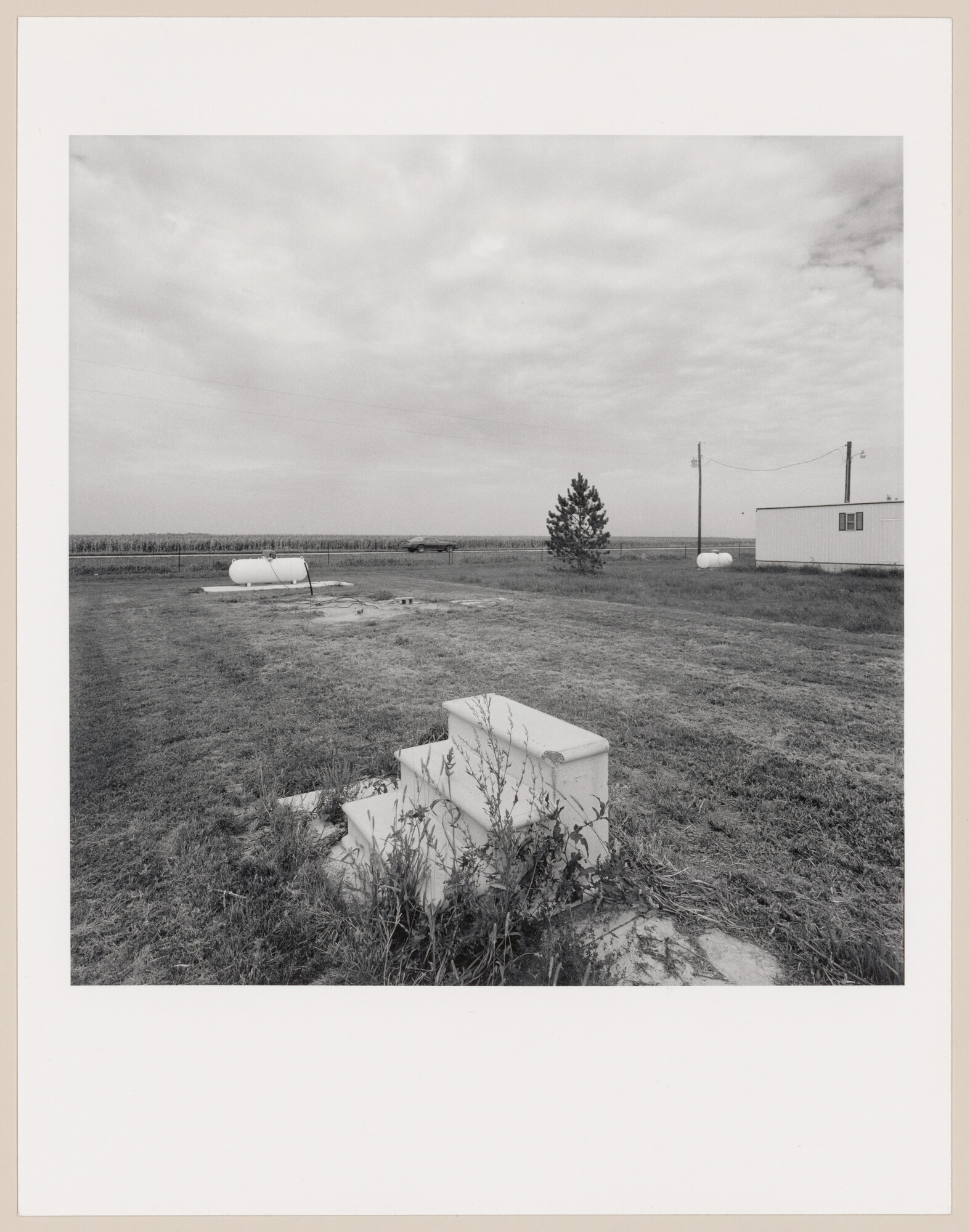
Laura Volkerding, Vacated mobile home lot, Iowa, 1978. PH1980:0447
Collection Canadian Centre for Architecture, Montréal © Center for Creative Photography, The University of Arizona Foundation
Overview
The 2026–2028 cycle of the CCA-WRI Research Fellowship Program explores vacancy as a cyclical condition—holding the potential to regenerate lands, structures and social relations in tandem. Vacancy suggests not emptiness and erasure, but rather conditions of return, renewal, and evolution that can reveal histories of marginalization.
Each summer from 2026 to 2028, CCA-WRI Research Fellows engage with specific sites from recently completed or active research and/or design projects to examine how vacant land, buildings, and other spatial conditions are generated across geographical contexts, urban and rural realities, political circumstances, and timeframes.
The program seeks to build an experimental research format that allows designers and researchers to ground ongoing projects in the CCA Collection through in-depth, historically informed research and exchanges with peer practitioner-academics from around the world. It aims to create a space in which theoretical exploration can move towards on-the-ground action.
Fellowship Support
・A monthly stipend of CAD 5,000 for up to three months
・Financial support for travel and visa costs
・Access to a dedicated office and the CCA Study Room
Residency Period
One to three months between July and October each year
Location
Canadian Centre for Architecture, Montréal, Canada
Open Call for the 2027 CCA-WRI Research Fellowship
Applications for the 2027 fellowship are open until 11:59 p.m. EST on 30 November 2026.
Building on the 2026 edition, the program invites projects that explore vacancy as a condition that encompasses and exceeds vacant buildings and land. We welcome proposals focused on specific sites contending with vacancy as a social, cultural, political, and spatial condition. Four fellowships will be awarded to individuals or teams.
For the full call and application details, visit the CCA website.
2026 CCA-WRI Research Fellowship
The 2026 cohort comprised five fellows working on four projects in Honolulu, St. Louis, the Kathmandu Valley, and Toyama Prefecture. Their research explored vacancy in relation to land ownership, disinvestment, disaster mitigation, and the renewal of craft traditions.
- Vacancy as Return: Rural–Urban Memoryscapes, Black Domesticity, and Community Agency
Rayshad Dorsey (Assistant Professor of Architecture, Sam Fox School of Design & Visual Arts, Washington University in St. Louis)
- Of No Use
Hiʻilei Hobart (Assistant Professor of Native and Indigenous Studies, Yale University) / Jake Hobart (Creative Director)
- The Perpetual Violence of the Kathmandu Valley: Future-Proof Infill Framework
Kent Mundle (Lecturer, University of Hong Kong)
- Self-Renovation as Cultural Infrastructure: An Archive of Craftspeople’s Experiential Intelligence for the Reoccupation of Vacant Houses
Yusuke Yabutani (Lecturer, University of Toyama)
Affiliations and titles are those held at the time of participation.
Advisory Committee
Giovanna Borasi
Director, Canadian Centre for Architecture
Maurice D. Cox
Emma Bloomberg Professor in Residence of Urban Planning and Design, Harvard Graduate School of Design
Rafico Ruiz
Associate Director, Research, Canadian Centre for Architecture
Mio Tsuneyama
Architect, studio mnm / HOLES
Related Articles
Past Events
- Self-Renovating and Frameworking Vacancy — A lecture by Yusuke Yabutani and Kent Mundle
10 Sep 2026
- Vacancy as Return and Renewal — A Lecture by Rayshad Dorsey, Hiʻilei Hobart, and Jake Hobart
27 Aug 2026
- What places get to define vacancy? — A discussion between Maurice Cox and Mio Tsuneyama marking the launch of a new edition of the CCA-WRI Research Fellowship Program
15 Jan 2026
CCA-WRI Research Fellowship Program
Learn more about the CCA-WRI Research Fellowship Program and its previous cycle here.